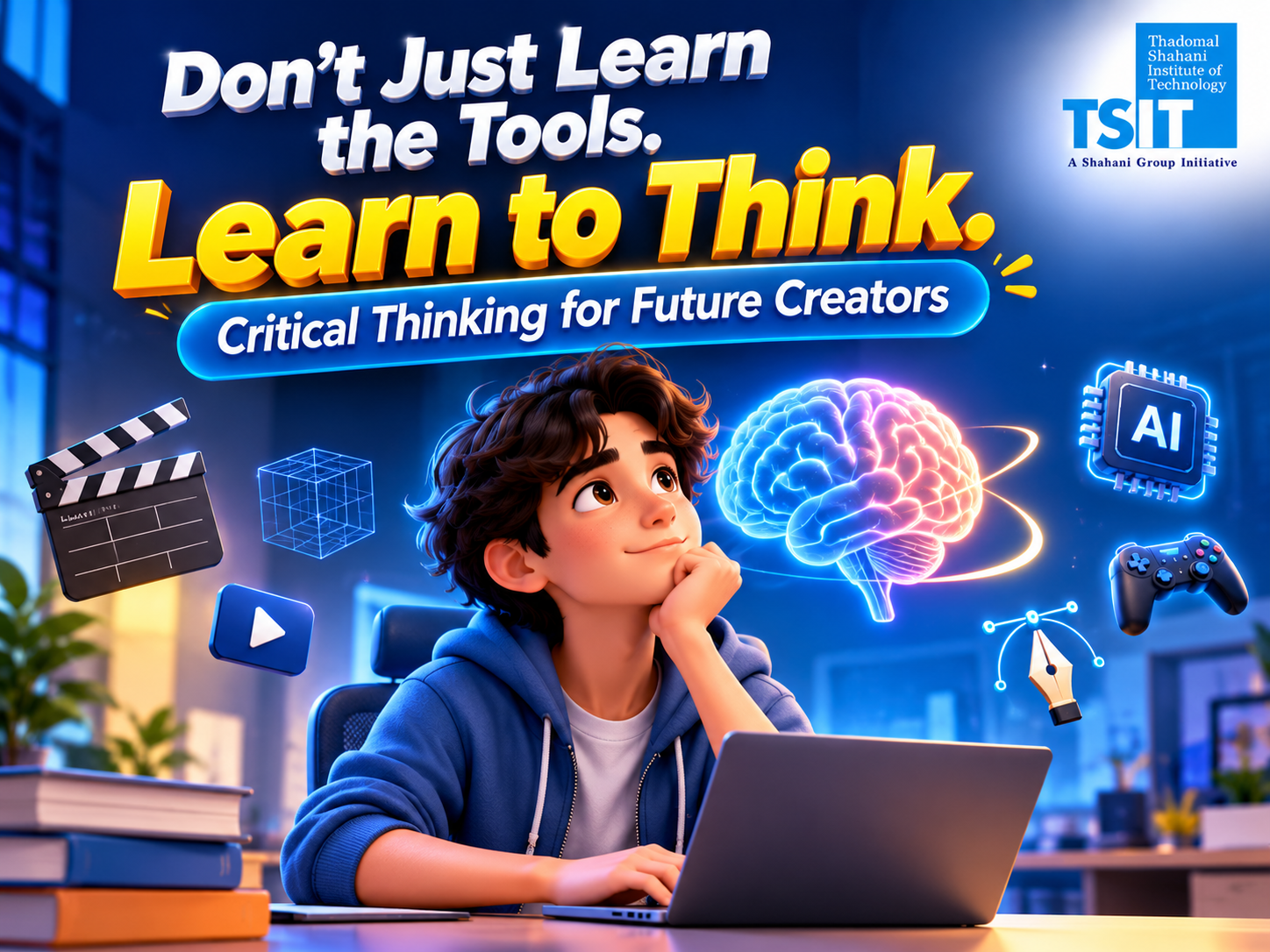
The Importance of Critical Thinking for Students in Animation and AI
Have you ever wondered why two students using the same software can create completely different results?
One might follow every tutorial exactly as shown. The other might experiment, ask questions, identify mistakes and find a better way to complete the project.
The difference is not always technical knowledge. Sometimes, it is the ability to think critically.
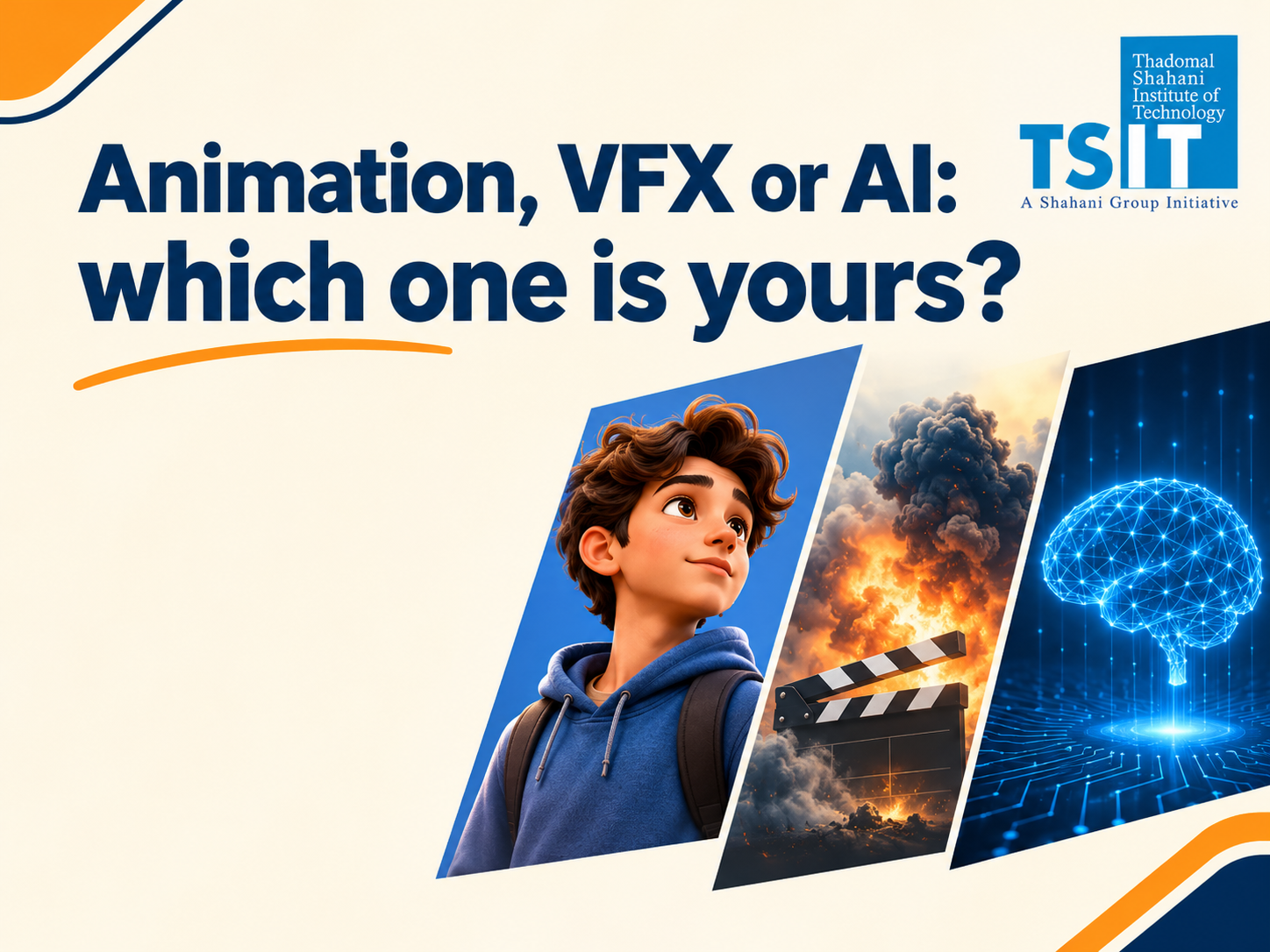
Whether you want to become a 3D animator, VFX artist, game artist or AI professional, learning software is only one part of the journey. You also need to understand problems, evaluate ideas and make decisions.
This is where critical thinking skills become important.
What is Critical Thinking?
Critical thinking is the ability to look at information carefully, ask the right questions and make decisions based on reasoning, not assumptions. In simple words, it means understanding why something works instead of just accepting that it works.
Let’s take an example. Imagine you are creating a 3D character animation. The character looks realistic, but the movement feels unnatural. Instead of starting the whole animation again, you stop and ask:
- Is the character’s timing correct?
- Does the movement show proper weight?
- Is the problem with the rig or the animation?
- What changes could make the movement more believable?
By checking the problem before changing anything, you are using critical thinking. You save time, and you also learn something new from the mistake.
The same idea works in AI. If an AI tool gives a wrong answer, a critical thinker checks the information first instead of trusting it straight away.
Why Is Critical Thinking Important for Students?
Critical thinking helps students go beyond memorising information and following instructions. It encourages you to understand concepts, solve problems on your own and check the quality of your own work.
This is especially useful if you are studying animation or AI. Both fields involve experiments, new technology and constant learning. Tools and software keep changing, but the ability to think clearly stays with you.
A software tool can help you finish a task. Critical thinking helps you decide what to create, how to improve it and whether the result meets your goal.
What Are the Benefits of Critical Thinking for Students?
1.Improves Problem-Solving Skills
Every creative or technical project comes with challenges.
An animator might struggle with unnatural character movement. A VFX artist might find that an effect does not match the lighting of a scene. An AI student might discover that a model produces inconsistent predictions.
Critical thinking encourages students to identify the cause of a problem rather than trying random solutions.
For example, if a 3D character’s movement looks unrealistic, the student can examine the timing, spacing and body mechanics before making adjustments.
This approach can make problem-solving more organised and effective.
2. Helps Students Make Better Decisions
Students make decisions throughout their learning journey, from choosing software to selecting a career specialisation.
Should you learn 3D modelling or character animation first? Is a particular AI tool suitable for your project? Which approach will produce the best result?
Critical thinking helps you compare options, understand their advantages and limitations, and make informed choices.
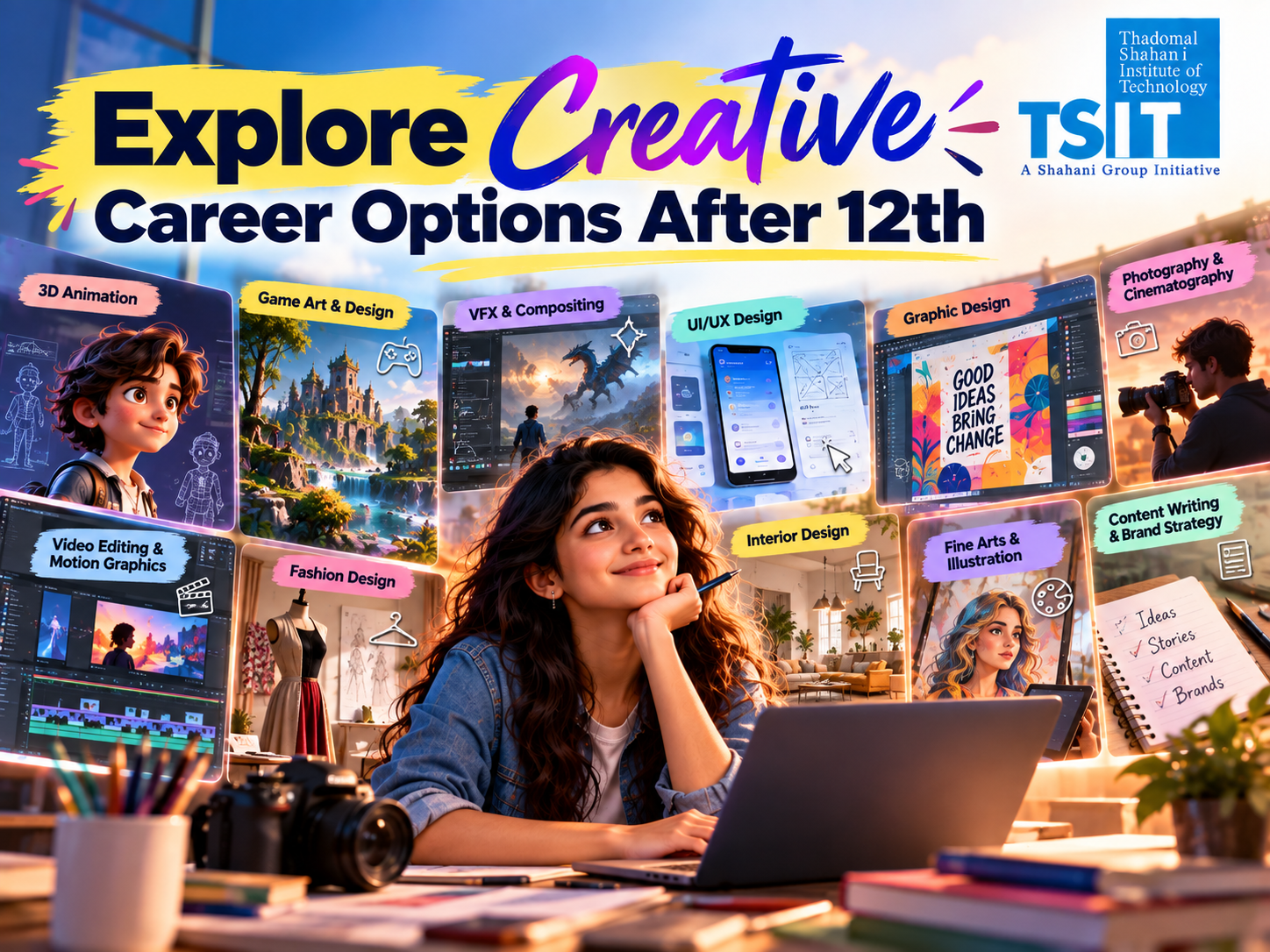
It also becomes useful when selecting a course after Class 12. Instead of choosing a programme based only on its name, students can compare the curriculum, practical training, software, projects and career opportunities.
3. Encourages Creativity and New Ideas
Creativity is not just about imagining something different. It also involves exploring whether an idea will work.
Suppose you are designing a futuristic city for an animated film.
You could create a familiar cityscape, or you could ask questions about how people live there, how transportation works and what makes the environment different.
These questions can lead to more thoughtful designs.
In animation, VFX and game art, critical thinking helps students evaluate ideas and develop creative solutions that serve the project’s purpose.
4. Develops Research and Analytical Skills
Good research is more than collecting information from websites or AI tools.
Students need to compare sources, check accuracy and decide which information is relevant.
For example, while researching AI animation tools, you might find several applications claiming to generate professional-quality animation in seconds.
Instead of accepting those claims, you could examine sample outputs, available features, limitations and whether the tool fits your requirements.
This habit becomes increasingly valuable as students work with AI-generated information and digital content.
5. Builds Confidence in Independent Learning
During a course, you can always ask your teacher for guidance. But when you work on your own projects, you often have to make decisions yourself.
Critical thinking gives you the confidence to look into a problem, test different solutions and learn from the result. It does not mean you must know every answer. It means you know how to approach a question when the answer is not clear straight away, which makes independent learning much less stressful.
6. Helps Students Use AI More Responsibly
AI tools can generate text, images, code and video, but their outputs are not always accurate or suitable.
For example, an AI-generated image might contain visual inconsistencies, while AI-generated code might fail to perform as expected.
Students who think critically are more likely to review these results, identify limitations and make necessary improvements.
They also learn to consider issues such as originality, copyright, accuracy and responsible use.
The goal is not just to use AI tools. It is to understand when and how to use them effectively.
How Can Students Develop Critical Thinking Skills?
Critical thinking is not something you build overnight. Like any other skill, it grows through regular practice, curiosity and reflection. The good news is that you can start with small habits in your daily learning. Here are five practical ways to begin.
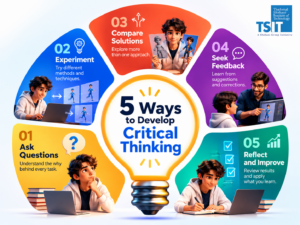
1. Ask More Questions
Whenever you learn something new, try asking why it works.
If a tutorial demonstrates a particular animation technique, consider why the artist chose it.
Could another technique achieve the same result? What would happen if you changed the settings?
Questions encourage deeper understanding.
2. Experiment Instead of Only Following Tutorials
Tutorials are useful for learning software, but students should also practise independently.
After completing a tutorial, try creating something different using the same techniques.
For example, if you learn how to animate a bouncing ball, experiment with how a heavy metal ball and a light rubber ball would move differently.
This helps connect technical learning with observation and reasoning.
3. Compare Different Solutions
A problem may have more than one solution.
If an AI-generated image does not match your intended style, you could modify the prompt, change the reference image or adjust the result manually.
Compare these approaches and identify which gives you better control.
Over time, this habit can improve your decision-making skills.
4. Learn From Feedback
Feedback is an important part of creative learning.
Instead of viewing corrections as criticism, try understanding why a particular change is recommended.
If your animation instructor suggests adjusting the timing of a scene, examine how that adjustment changes the character’s movement.
The aim is not simply to make the correction but to understand the reasoning behind it.
5. Review Your Own Work
After completing a project, ask yourself:
- What worked well?
- What problems did I face?
- Which decisions improved the result?
- What would I do differently next time?
This reflection can help you recognise patterns and improve future projects.
How Does Critical Thinking Help in Animation and AI?
Although animation and AI involve different technical skills, both require students to analyse problems and make decisions.
Field | Example of Critical Thinking |
3D Animation | Identifying why character movement looks unnatural |
3D Modelling | Choosing suitable modelling techniques for a project |
VFX | Evaluating lighting, perspective and visual consistency |
Game Art | Balancing visual quality with game performance |
Graphic Design | Selecting layouts and visual elements that communicate clearly |
Artificial Intelligence | Checking model outputs, data quality and accuracy |
AI-Assisted Animation | Evaluating and refining AI-generated movement or visuals |
Consider a student creating an animated short film.
The student must decide how the characters move, how the scenes connect, which visual style communicates the story and whether the final animation feels believable.
Software provides the tools to create the film. Critical thinking helps guide the creative decisions behind it.
Can Critical Thinking Help You Work Better With AI Tools?
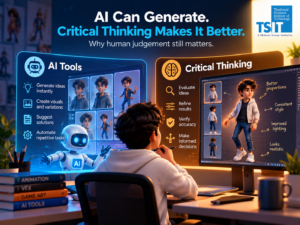
Yes. Critical thinking becomes especially useful when you work with generative AI. AI can create results quickly, but it cannot always tell whether those results are right for your project. That decision is still yours.
Let’s take an example. You use an AI tool to create a character design for your animation project. The result looks impressive. But when you look closely, the character’s clothes change between images, the proportions are inconsistent and the design does not fully match your story.
If you accept the result just because it looks attractive, you may face problems later. If you think critically, you spot what needs improvement and decide how to fix it. You might change the prompt, add a reference image or correct the design by hand.
The same idea applies to AI-generated code, data analysis and automation. AI can help you produce results faster, but you still need to check whether they are accurate, suitable and useful.
Why Do Critical Thinking Skills Matter for Future Careers?
Creative and technology jobs rarely come with complete instructions. An animator may need to understand a director’s feedback, a game artist may need to make a detailed environment run smoothly, and an AI professional may need to find out why a model gives unexpected results. In each case, knowing which software buttons to press is not enough. You also need to observe carefully, communicate clearly, solve problems and use good judgement.
That is why critical thinking is a transferable skill. It helps you adapt to different roles as tools and workflows change.
How Can Students Build Creative and Technical Skills at TSIT?
For students interested in animation and AI, choosing a learning environment that encourages practical application is an important consideration.
Backed by the Shahani Group’s 100+ year legacy in education, Thadomal Shahani Institute of Technology (TSIT) offers programmes across areas such as 3D Animation, VFX, Game Art and Artificial Intelligence.
Students can explore learning pathways that combine software training, practical assignments and project-based learning.
When evaluating a programme, look at how its curriculum helps you understand concepts, apply technical skills and develop independent projects.
Explore TSIT’s 3D Animation and VFX programmes and Artificial Intelligence programmes to find a learning path that matches your interests.
Frequently asked questions
1. What are critical thinking skills for students?
Critical thinking skills help students analyse information, ask questions, evaluate different solutions and make informed decisions.
2. Why is critical thinking important in animation?
Critical thinking helps animators identify movement problems, evaluate visual choices, improve storytelling and find suitable solutions during production.
3. How is critical thinking useful in artificial intelligence?
It helps students assess AI-generated results, examine data, identify errors and understand the limitations of AI tools.
4. Can creative students improve critical thinking?
Yes. Students can develop critical thinking by experimenting with different techniques, comparing solutions, seeking feedback and reviewing their own projects.
5. Is critical thinking important for future jobs?
Critical thinking is useful across many careers because it supports problem-solving, decision-making, communication and adaptability.
Final Thoughts
Learning animation or AI is not only about mastering the latest software.
It is also about understanding problems, questioning results, exploring possibilities and making thoughtful decisions.
Whether you are creating your first 3D character, experimenting with AI tools or planning a future career, critical thinking can help you become a more independent and capable learner.
The tools you learn may change over time. Your ability to think, question and solve problems will remain valuable.