
Share
Career Options After 12th for Creative Students: Courses, Skills & Opportunities
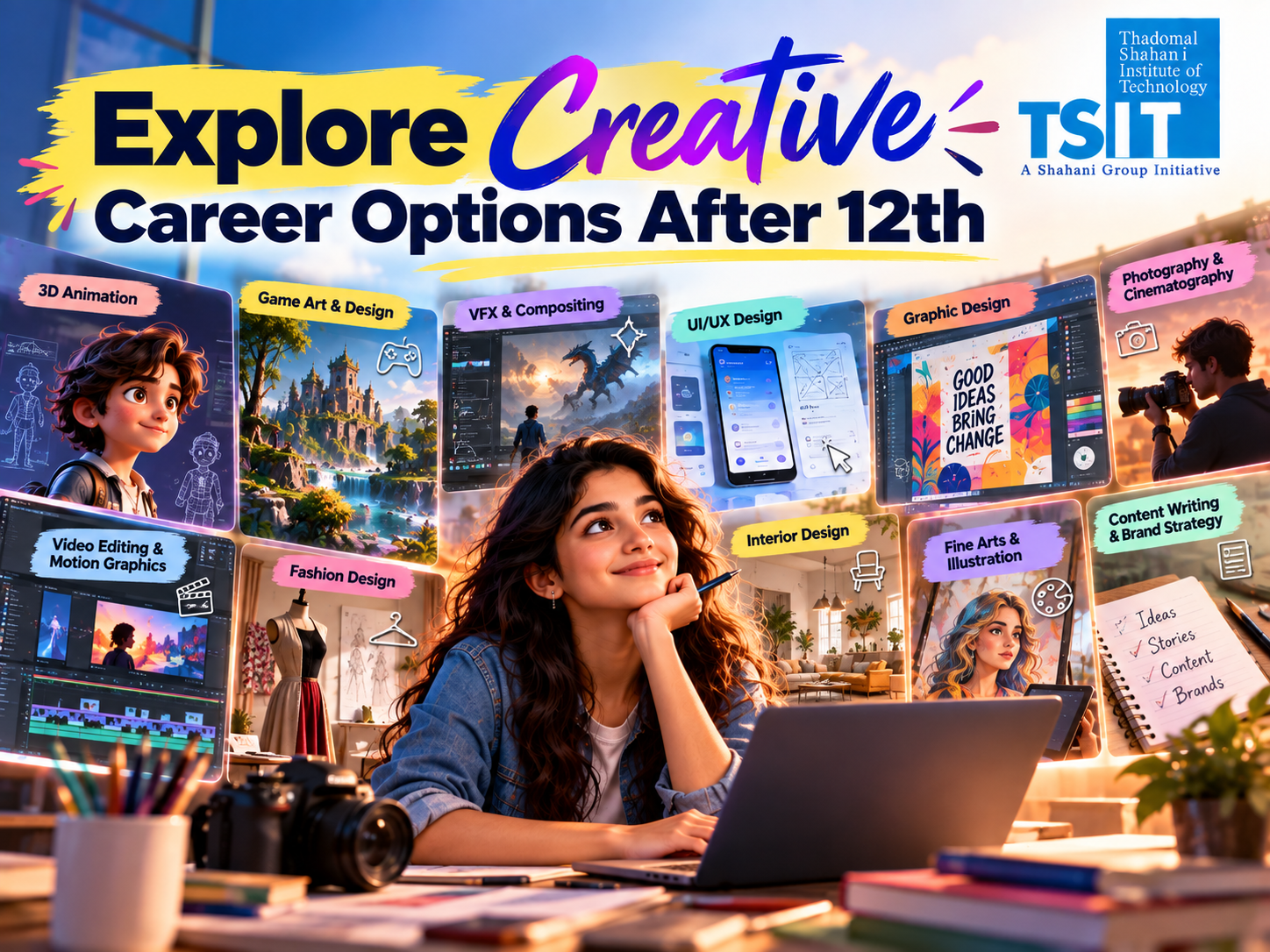
Choosing a career after Class 12 can feel confusing, especially when your interests go beyond traditional career options.
Maybe you enjoy drawing characters, editing videos, taking photographs, designing posters, playing with 3D software, writing stories, creating social media content, or understanding how games are made. These interests can point towards a range of creative career paths.
The important part is understanding what each career involves, what skills you need, and how you can start.
This guide explores 6 creative career options after 12th, along with the skills, tools, learning paths, and opportunities associated with each one.
– Why Are More Students Exploring Creative Careers?
Creative work today goes far beyond traditional art and design.
Films need animators and VFX artists. Games need 3D artists and designers. Apps and websites need UI/UX designers. Brands need graphic designers, video editors, photographers, writers, and content creators.
India’s media and entertainment industry has also grown significantly in recent years, creating opportunities across digital media, animation, VFX, gaming, advertising, and online content.
Technology is also changing the way creative work is produced. Tools for 3D design, video editing, digital illustration, game development, and AI-assisted creation are making creative skills relevant across many industries.
For students, this means creativity can be developed into a practical professional skill when it is supported by the right training, practice, and portfolio.
Start Here: What Kind of Creative Work Interests You?
Before choosing a course, think about the kind of work you
| If you enjoy… | You can explore… |
| Drawing characters and telling stories | Animation, Illustration, Game Art |
| Creating layouts and visual designs | Graphic Design, UI/UX |
| Games and digital worlds | Game Art, 3D Animation |
| Editing videos and creating visual effects | Video Editing, Motion Graphics, VFX |
You don’t have to make a final career decision immediately. The purpose is to identify two or three areas that you would like to explore further.
Four Questions to Ask Yourself
Before choosing a creative field, ask yourself:
- Do I enjoy creating things visually, writing, or working with ideas?
- Do I prefer working independently or as part of a creative team?
- Am I comfortable receiving feedback and improving my work?
- Would I enjoy practising a creative skill regularly?
Your answers can help narrow down the options.
6 Creative Career Options After 12th
Let’s look at some of the creative fields students can explore after Class 12.
1. 3D Animation
3D animation is the process of creating characters, objects and environments in a three-dimensional digital space. It is used in films, games, advertising and digital content.
Students interested in this field can explore an Advanced Course in 3D Animation to understand how skills such as modelling, texturing, rigging, animation, lighting and rendering are developed through practical training.
What You May Work On
You could work on characters, environments, animated scenes, product visuals, films, games, or digital content.
Skills You Develop
- 3D modelling
- Texturing
- Rigging
- Character animation
- Lighting
- Rendering
Common Tools
Maya, 3ds Max, Blender, ZBrush, and other 3D production tools.
Career Opportunities
Possible roles include:
- 3D Animator
- Character Animator
- 3D Modeler
- Environment Artist
- Rigging Artist
- 3D Generalist
Students can enter the field through animation courses, specialised training programmes, or degree programmes after Class 12.
(In this paragraph, i will add the Internal link of 2nd animation blog)
2. VFX and Compositing
VFX combines live-action footage with digitally created elements to produce scenes that may be difficult or impossible to capture with a camera alone.
Students interested in compositing, tracking, rotoscoping and post-production can explore the Advanced Course in VFX to understand the skills and software used in VFX production.
Skills You Develop
- Compositing
- Tracking
- Rotoscoping
- Colour matching
- Visual effects
- Attention to detail
Common Tools
Nuke, After Effects, Maya, and other VFX software.
Career Opportunities
Students may explore roles such as:
- VFX Artist
- Compositor
- Roto Artist
- Tracking Artist
- Lighting Artist
These skills can be used across films, OTT content, advertising, and digital production.
3. Game Art and Design
Game art focuses on the visual side of games, including characters, environments, props and other digital assets. Game design focuses more on gameplay, levels and the overall player experience.
Students interested in creating game-ready assets and real-time environments can explore the Professional Course in Game Art with Unreal Engine. The programme covers areas such as 3D modelling, texturing, environment design, world-building and Unreal Engine workflows.
Skills You May Learn
- 3D modelling
- Character creation
- Environment design
- Texturing
- Game design fundamentals
- Real-time workflows
Common Tools
Maya, Blender, Unreal Engine, Unity, and related tools.
Career Opportunities
Possible roles include:
- Game Artist
- Environment Artist
- Character Artist
- Game Designer
- 3D Asset Artist
The exact skills required depend on whether you choose the art or design side of gaming.
4. Graphic Design
Graphic design is about communicating ideas visually.
Graphic designers work on everything from brand identities and advertisements to social media creatives, packaging, brochures, and digital campaigns.
Students who want to develop practical skills in visual communication, typography, branding, and digital design can explore the Expert Course in Graphic Design to understand the curriculum, tools, projects, and portfolio development involved.
Skills You Develop
- Typography
- Colour
- Composition
- Layout
- Branding
- Visual communication
Common Tools
Photoshop, Illustrator, Figma, and other design tools.
Career Opportunities
You may explore roles such as:
- Graphic Designer
- Visual Designer
- Brand Designer
- Social Media Designer
Graphic designers work in agencies, companies, media teams, studios, and freelance projects.
UI/UX design focuses on creating digital experiences that are easy and enjoyable to use.
UI, or User Interface, focuses on how a digital product looks.
UX, or User Experience, focuses on how people use and experience that product.
Students interested in designing websites, mobile apps, and digital products can explore the Expert Course in UI / UX Design to understand areas such as user research, wireframing, prototyping, usability testing, and portfolio development.
Do You Need Coding?
You don’t necessarily need to be a programmer to begin learning UI/UX design. The field focuses heavily on research, user behaviour, wireframes, layouts, prototypes, and design thinking.
Common Tools
Figma and other prototyping and design tools.
Career Opportunities
Possible roles include:
- UI Designer
- UX Designer
- UX Researcher
- Product Designer
5. Video Editing and Motion Graphics
Every video you watch online has a story behind its edit.
Video editors decide which shots stay, which are removed, how scenes flow, and how music, sound, text, and visuals work together.
Motion graphics adds movement to graphic elements such as typography, icons, illustrations, and titles.
Students interested in developing practical editing and post-production skills can explore the Expert Course in Video Editing to learn more about editing workflows, storytelling, audio, colour correction, projects, and portfolio development.
Skills You Develop
- Video editing
- Storytelling
- Pacing
- Sound and music placement
- Motion design
Common Tools
Premiere Pro, After Effects, DaVinci Resolve, and similar editing tools.
Career Opportunities
Students can explore opportunities as:
- Video Editor
- Motion Graphics Designer
- Content Editor
- Post-Production Artist
Opportunities can exist in studios, agencies, brands, production teams, and freelance work.
6. Fine Arts and Illustration
Fine arts and illustration are suitable for students who enjoy drawing, painting, visual storytelling, and developing their own creative style.
Illustrators can create work for books, advertising, editorial publications, games, brands, and digital media.
Skills You Develop
- Drawing
- Composition
- Colour
- Illustration
- Visual storytelling
Tools
Traditional drawing and painting materials may be combined with digital tools such as Photoshop and Procreate.
Career Opportunities
Possible paths include:
- Illustrator
- Concept Artist
- Digital Artist
- Freelance Artist
At TSIT, students can explore skill-based programmes across creative fields such as 3D Animation, VFX, Game Art, Graphic Design, UI/UX and Video Editing. The focus is on practical learning, industry-relevant tools and projects that help students develop skills through hands-on work.
Comparing Creative Career Options After 12th
Different creative fields require different skills and learning paths.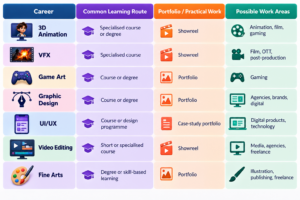
What Affects Salary in a Creative Career?
There isn’t one salary figure that applies to every creative career.
Starting salaries can vary depending on:
- Your chosen field
- Location
- Employer
- Practical skills
- Software knowledge
- Portfolio or showreel
- Specialisation
- Previous project experience
For example, a 3D animator, UI/UX designer, photographer, and copywriter all work in creative industries, but their skills and employment markets are different.
Instead of choosing a career only because of a salary figure, consider whether you are interested enough in the field to continue developing your skills over time.
Specialisation Can Matter as You Progress
At the beginning of your career, you may learn several skills.
As you gain experience, you may decide to specialise.
A 3D artist might specialise in character animation. A designer might move towards UI/UX. A video editor might specialise in motion graphics. A writer might move towards advertising copy or brand strategy.
Specialisation can help you build deeper expertise in an area that interests you.
How to Start a Creative Career After 12th?
There is no single route into every creative field.
Depending on the career you choose, there are several possible learning paths.
Route 1: Entrance-Based Design Colleges
Some design institutes use entrance examinations as part of their admission process.
Examples include entrance routes associated with institutions such as NID and NIFT, as well as design entrance examinations such as UCEED.
Eligibility, examination patterns, and application dates can change, so students should always check the current requirements on the relevant official website before applying.
Route 2: Degree Programmes
Students can also explore degree programmes in areas such as:
- Animation
- Design
- Fine Arts
- Fashion
- Multimedia
- Related creative disciplines
Admission requirements vary between universities and institutes. Some may use Class 12 marks, while others may require an entrance test, portfolio, interview, or a combination of these.
Route 3: Skill-Based and Specialisation Courses
Students who already know which practical skill they want to develop can explore specialised courses.
These may focus on areas such as:
- 3D Animation
- VFX
- Game Art
- Graphic Design
- UI/UX
- Video Editing
The duration can vary depending on the depth and level of the programme.
Thadomal Shahani IT follows this skill-based approach across its creative programmes. Students can choose specialised pathways in areas such as 3D Animation, VFX, Game Art, Graphic Design and Video Editing, with training focused on practical projects, industry-standard software and portfolio development.
Can Arts, Commerce and Science Students Apply?
Many creative programmes are open to students from different Class 12 streams.
However, eligibility is not the same for every course or institute. Some degree programmes or entrance examinations may have specific academic requirements.
Always check the eligibility criteria for the particular programme you are considering.
How to Build a Portfolio When You Have No Experience?
One of the biggest questions students ask is:
“How can I make a portfolio if I’ve never worked professionally?”
Your first portfolio doesn’t need client work.
It can contain projects you created yourself to demonstrate what you can do.
This is also why practical projects matter when choosing a creative course. At TSIT, portfolio development is built into several creative programmes, allowing students to develop work through assignments and projects as they learn, rather than waiting until the end of the course to start building a portfolio.
What Can a Beginner Portfolio Include?
Depending on your field, you could include:
- Drawings
- Character designs
- Posters
- Logo concepts
- UI screens
- Photography
- Short videos
- 3D models
- Animation tests
- Writing samples
- Campaign ideas
Where possible, show some of your process too.
For example, instead of showing only a finished poster, you could include the first idea, rough layout, revisions, and final design.
This helps people understand how you approach creative work.
Try a 60-Day Starter Plan
You don’t need to create everything at once.
For the next 60 days, you could:
- Practise one small skill regularly
- Complete one small project each week
- Create one larger personal project
- Collect your strongest work into a simple portfolio
The goal is not perfection. It is to start creating consistently and learn from each project.
Free Tools You Can Start With
Depending on your interests, beginner-friendly tools may include:
- Blender for 3D
- Figma for UI/UX
- Canva for basic design
- GIMP for image editing
- A smartphone camera for photography and video
You don’t need expensive equipment to explore whether you enjoy a field.
Where Can You Show Your Portfolio?
Depending on your creative field, you can use platforms such as Behance, ArtStation, Instagram, or a simple PDF portfolio.
Choose a format that makes your work easy to view and update.
Skill-Based Routes to Creative Careers
A degree is one way to enter a creative field, but it isn’t the only learning route for every career.
Some students begin with specialised courses, self-learning, internships, freelance projects, or personal projects.
The right route depends on your career goal.
1. Self-Learning
Online tutorials and learning platforms can be useful for understanding individual tools and techniques.
They can help you explore a field before committing to a longer programme.
However, self-learning requires discipline. You need to decide what to learn, practise regularly, identify your mistakes, and find feedback on your own work.
2. Freelancing
Some creative professionals work independently rather than joining a company full-time.
Freelancing can be found in areas such as:
- Graphic design
- Video editing
- Photography
- Content writing
- Illustration
For beginners, building a portfolio and gaining experience through smaller projects can be a practical starting point.
How Is AI Changing Creative Careers?
AI is changing the way creative professionals work.
AI-powered tools can help with tasks such as generating ideas, creating design variations, assisting with editing, exploring visual concepts, and speeding up parts of a creative workflow.
This doesn’t mean creative skills are no longer important.
Skills such as creative thinking, storytelling, visual judgment, communication, problem-solving, and understanding what a client or audience needs remain valuable.
For students entering creative fields, learning how to use AI tools responsibly can become another part of their creative skill set.
Not Sure Which Creative Career to Choose?
You don’t need to choose your entire career in one day.
Instead, start by exploring.
Choose two fields from this guide that interest you most.
Spend a few days watching beginner tutorials and trying a small project in each one. Look at portfolios created by professionals in those fields. If possible, visit an institute, attend a workshop, or speak with someone already working in the industry.
After trying the actual work, ask yourself:
Which activity did I enjoy enough to keep practising even when it became difficult?
That answer can tell you more than simply choosing a course based on its name.
What Should a Career Counselling Session Help You Understand?
A useful career counselling session should help you understand:
- Which fields match your interests
- What each course teaches
- Eligibility requirements
- Course duration
- Software and skills covered
- Possible career paths
- Admission process
Use counseling as an opportunity to ask questions and compare your options before making a decision.
Frequently Asked Questions
1. What creative career options can I explore after 12th?
Students can explore areas such as 3D animation, VFX, game art, graphic design, UI/UX, video editing, fine arts.The right choice depends on your interests, strengths, and preferred type of work.
2. Can Arts or Commerce students do creative courses?
Many creative courses accept students from Arts, Commerce, and Science backgrounds. However, eligibility varies by programme and institute, so always check the requirements for the specific course before applying.
3. Are there creative career options after 12th without Maths?
Yes. Many creative fields do not require Maths as a general entry requirement. However, certain degree programmes, architecture-related courses, or entrance examinations may have specific academic requirements, so check the eligibility criteria carefully.
4. Do I need to be good at drawing?
Not for every creative career. Drawing can be useful for fields such as illustration, fine arts, character design, and some areas of animation. Fields such as video editing, UI/UX rely on different skills.
5. Do I need an entrance exam for creative courses?
It depends on the institute and programme. Some design institutes have entrance examinations, while many private institutes and skill-based programmes have different admission processes. Always check the current requirements of the institute you are considering.
6. How long are creative courses after 12th?
Course duration can range from short-term programmes lasting a few weeks or months to degree programmes lasting three or four years. The right duration depends on the field, programme level, and depth of training you want.
7. What affects salary in a creative career?
Salary can depend on the field, city, employer, experience, specialisation, software knowledge, portfolio quality, and practical skills. Because creative careers vary widely, there isn’t one salary range that applies to every student or profession.
8. Can I get a creative job without a degree?
Some creative roles may place strong importance on practical skills, portfolios, showreels, or writing samples. However, requirements vary between employers and roles. A degree may also be required or preferred for certain career paths.
9. Which software should I learn first?
Start with software related to the field you want to explore. For example, students interested in animation may begin with Maya or Blender, while graphic design students may explore Photoshop and Illustrator. UI/UX students commonly use Figma, and video editors may work with Premiere Pro or DaVinci Resolve.
You don’t need to learn every tool at once.
10. How do I build a portfolio if I have no experience?
Start with personal projects. Create designs, illustrations, 3D models, photographs, videos, writing samples, or other work related to your chosen field. Focus on demonstrating your skills and creative process rather than waiting until you have professional client work.
Explore Creative Courses at TSIT
Thadomal Shahani Institute of Technology (TSIT) offers career-focused learning options across creative fields such as 3D Animation, VFX, Game Art, Graphic Design, UI/UX and Video Editing, along with programmes in emerging areas such as AI.
TSIT’s approach focuses on practical learning, hands-on projects, industry exposure and career-oriented training. Depending on the programme, students work with industry-relevant software and develop projects, portfolios or showreels that demonstrate the skills they build during the course. Thadomal Shahani Institute of Technology
TSIT also brings the 100+ years of education legacy of the Thadomal Shahani brand to newer creative and technology careers, while working with college partners and industry professionals to connect learning with current career requirements. Thadomal Shahani Institute of Technology
With different course levels available, students can choose a learning path based on their interests, career goals and the depth of training they need.
Not Sure Which Creative Course Is Right for You?
Speak to a TSIT counsellor to compare course options, curriculum, eligibility, duration, software, projects and the admission process before making your decision.