Bachelor's Degree in AI: What You Learn and Where It Leads
If you’re comparing an artificial intelligence course with a traditional computer science degree, you’ll find considerable overlap. However, an AI-focused degree places greater emphasis on areas such as machine learning, data science, deep learning, natural language processing, and the tools used to develop AI applications.
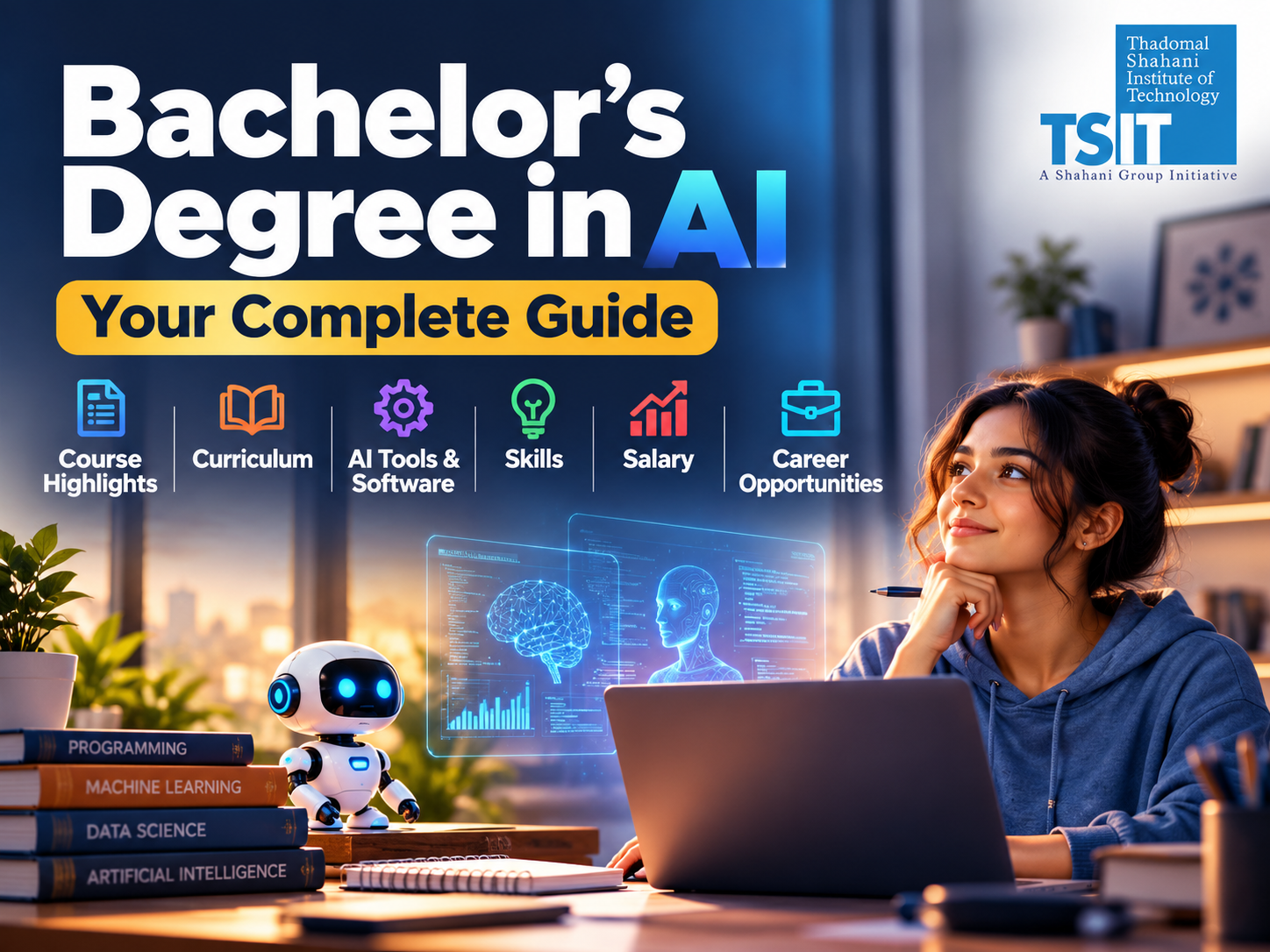
In this guide, we’ll look at what a Bachelor’s Degree in AI typically covers across six semesters, the practical skills students can develop, and the career paths they can explore after graduation.
What is a Bachelor’s degree in AI?
A Bachelor’s Degree in AI is a three-year undergraduate programme that combines core computer science subjects, such as programming, mathematics and databases, with specialised areas including machine learning, deep learning, NLP and computer vision.
Unlike a short-term AI course that may focus on one tool or skill, a full degree builds the foundation first. Students begin with programming, statistics and data handling, then move gradually into more advanced AI applications.
B.Sc. in Artificial Intelligence at a Glance
| Course at a Glance | Details |
| Programme | B.Sc. in Artificial Intelligence |
| Duration | 36 months / 6 semesters |
| Study mode | Full-time |
| Curriculum structure | NEP 2020 Compliance |
| Eligibility | 12th Pass & Above |
| Specialisation | Specialisation track begins in Semester 5 |
| Tools & technologies | 30+ across the programme |
| Major practical work | Community Engagement Project, Field Project and Capstone Project |
| Campuses | Ulhasnagar, Bandra, Mulund, Malad, Prabhadevi |
2. What Will I Learn in Each Semester?
TSIT’s B.Sc. in Artificial Intelligence builds progressively across six semesters, starting with foundations and moving towards specialisation, deployment and a capstone project.
Semester 1 & 2: Building the base
The first year is less about “AI” in the exciting sense and more about building the skills AI depends on. Expect subjects like:
- Foundations of Artificial Intelligence and Python programming fundamentals
- Data handling with Excel, plus a developer toolkit covering Linux, Git, and GitHub
- Data Structures & Algorithms using Python
- Mathematical Foundations for AI, with a hands-on NumPy lab
- Statistics for Data Science
- An early Machine Learning Foundation Lab
- Gen AI and Prompt Engineering – yes, even in Year 1
- Softer but important subjects: Design Thinking, Critical Thinking, Business Communication, and Economics for Professional Career
If you’re worried about starting without a coding background, this is exactly why the first two semesters begin from zero and build up gradually.
Semester 3 & 4: Machine learning, deep learning, and language
This is where the course starts to feel like a proper artificial intelligence course in the fuller sense. Typical subjects include:
- Machine Learning Foundations, plus continued Data Structures & Algorithms
- Database Management Systems for AI
- Linear Algebra & Multivariable Calculus for AI
- Cloud Computing for AI and MLOps
- Data Warehousing and Data Mining
- Cyber Law & Data Privacy for AI
- Deep Learning Foundations and Natural Language Processing
- Probability & Statistical Inference, with applied statistics practicals
- MLOps & Model Deployment
- Data Analytics & Visualization using Power BI
- A Community Engagement Project
By the end of Year 2, students can begin applying what they have learned to practical machine learning projects, moving beyond classroom concepts to building and working with functional models.
Semester 5 & 6: Specialise, deploy, and build a capstone
The final year is about depth and direction:
- Computer Vision & Image Processing, with a dedicated practical lab
- A Specialisation Track you choose yourself (theory + practical, continued across both semesters)
- Business Intelligence & Data Storytelling, with BI tools labs (Power BI/Tableau)
- Linux & DevOps for AI
- AI Agents & Robotic Process Automation
- Advanced Machine Learning & Deep Learning
- AI Ethics, Governance & Explainability
- Applied Research Methods for AI
- Web Development for AI Applications and Cybersecurity for AI Systems
- A Field Project in Semester 5, and a full Capstone Project plus On-the-Job Training or a Research Project in Semester 6
This is also where students usually build the strongest piece of their portfolio- the project that actually comes up in job interviews.
It’s not just code
A good AI degree doesn’t only teach technical skills. Subjects like Design Thinking, Critical Thinking, Entrepreneurship, Economics, Financial Literacy & Digital Payments, Cyber Law, and AI Ethics & Governance show up alongside the coding modules throughout all three years. This matters more than it sounds, companies hiring for AI roles increasingly want people who understand the responsible use of AI, not just how to train a model.
3. Tools and software you will actually use
| Category | Examples |
| Programming languages | Python, SQL, HTML5, CSS3, JavaScript basics |
| ML & AI frameworks | TensorFlow, PyTorch, Scikit-learn, Keras |
| Data science & analytics | NumPy, Pandas, Matplotlib, Seaborn, Jupyter Notebook |
| Databases | MySQL, SQLite |
| Dev environments | VS Code, PyCharm, Google Colab, JupyterLab |
| Generative AI | ChatGPT, Google Gemini, OpenAI API fundamentals, prompt engineering tools |
| Computer vision | OpenCV, TensorFlow vision libraries |
| Version control | Git, GitHub |
| Productivity | MS Office (Word, Excel, PowerPoint), Google Workspace |
What Will I Create During the Course?
Instead of only theory, the course is structured around real, practical outputs you can show off later:
- Early AI model practicals and data analysis projects (Year 1)
- A predictive model, database design project, and a machine learning lab project (Year 2)
- A computer vision project and BI dashboard (Semester 5)
- An AI chatbot or NLP-based tool
- Prompt engineering and Gen AI content projects
- A Field Project and Community Engagement Project
- A final Capstone Project tying everything together in Semester 6
If hands-on learning is an important part of your college decision, review the AI course curriculum and practical learning structure to see how classroom concepts progress into labs, projects, and a final capstone.
This project trail is often what separates one graduate from another when it comes to job interviews, a degree gets you in the door, but a portfolio gets you hired.
4. What Can I Do After a Bachelor’s Degree in AI?
A Bachelor’s Degree in AI can open up different opportunities in technology, data and automation. After graduation, students can explore entry-level roles in AI-related fields, pursue higher studies or build specialised skills in areas such as machine learning, data science and AI development.
The right path depends on your interests, practical skills, project experience and career goals. Before exploring specific job roles, it helps to understand the growing demand for AI skills across industries.
Is There Real Demand for AI Skills?
Yes. AI and data skills are becoming increasingly relevant across industries such as IT, financial services, e-commerce, healthcare, manufacturing, telecom, EdTech, research, and technology startups.
However, completing an AI degree does not automatically lead to a particular role. Career opportunities can depend on your technical skills, project portfolio, internships, specialisation, communication skills, and the requirements of individual employers.
What Entry-Level Roles Can I Explore?
After completing a Bachelor’s Degree in AI, graduates may explore entry-level roles such as:
- Junior AI Engineer or Junior Machine Learning Engineer
- Data Analyst or Junior Data Analyst
- Python Developer or AI Application Developer
- MLOps or Cloud AI Associate
- NLP Developer or Computer Vision Engineer
- AI Chatbot Developer or Conversational AI Specialist
- AI Automation Specialist or RPA Developer
- Research Associate in AI or Data Science
What Salary Can I Expect After an AI Degree?
Entry-level salaries in AI and machine learning in India can vary widely depending on the role, location, company, technical skills, internships, and project experience. Based on current salary submissions and job listings, early-career AI/ML roles commonly appear in roughly the ₹4–10 LPA range, although some positions may offer salaries below or above this range. Glassdoor
As students gain experience and specialise in areas such as machine learning, MLOps, computer vision, NLP, or Generative AI, salary opportunities can change significantly. These figures represent general market data and not guaranteed salaries or TSIT placement outcomes.
How Can My Career Grow Over Time?
Career progression varies depending on your role, organisation, skills, specialisation, and experience.
One possible career path could look like:
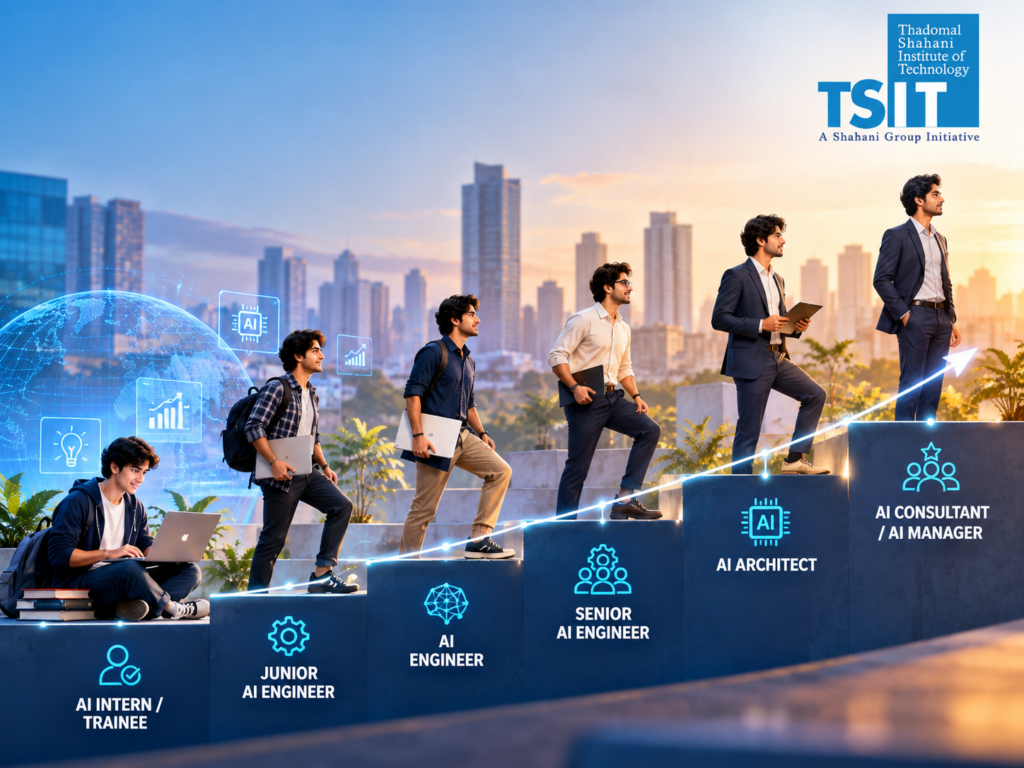
Graduates may also move into areas such as data science, MLOps, AI automation, computer vision, NLP, or AI product development as they build experience and specialise.
Can I Continue My Studies After a Bachelor’s Degree in AI?
Yes. Students who want to specialise further may explore postgraduate options such as an M.Sc. in AI or Data Science, MCA, MBA in Analytics, or other related programmes.
Eligibility and admission requirements can vary by university and programme, so students should check the requirements of the institution they plan to apply to.
5. Is a Bachelor’s Degree in AI Right for Me?
Worried about the maths?
Mathematical Foundations for AI starts in Semester 2; the heavier maths (Linear Algebra, Multivariable Calculus, Probability & Statistical Inference) comes in Year 2, once you already have a base.
Never coded before? Python
programming fundamentals begin in Semester 1, taught assuming no prior experience, alongside a developer toolkit covering Linux, Git, and GitHub.
Wondering if it’s too hard?
There are practical labs in every semester and steady, structured coding practice – the pace is designed to build up gradually rather than throw you in the deep end.
Can you join straight after Class 12?
Most programs, including this one, accept students from any stream after Class 12, which makes it a genuinely accessible AI course after 12th, without needing a separate entrance exam like JEE in most cases (always confirmed with the specific college).
If you’re specifically exploring an AI course after 12th, check the latest eligibility criteria, course duration, curriculum, and admission requirements before applying.
Not ready for a 3-year commitment?
Shorter, focused options – fundamentals courses running a few weeks, or professional courses over a few months – exist if you want to test the waters first.
6. How Do I Choose a College for an AI Degree?
Look beyond the course title. These six factors can help you compare programmes more clearly.
- Curriculum currency
Check whether all semesters are published and whether the syllabus includes current areas such as Generative AI, AI agents, MLOps, model deployment and responsible AI. Ask how often the curriculum is reviewed.
- Practical learning
Look at how much of the programme is taught through labs, projects and applied work. Ask how practical hours are structured alongside lectures.
- Tools and software
Check whether students work with tools used in AI, data science, development, cloud and version control. Ask whether the software and lab access are available throughout the programme.
- Degree recognition
Confirm which university awards the degree and whether the programme and institution meet the recognition requirements relevant to your future study or career plans.
- Projects and industry exposure
Look for field projects, capstones, research opportunities, internships or other ways to apply learning outside routine classroom assignments.
- Career support
Ask what career support actually includes, such as resume guidance, interview preparation, portfolio or project reviews, employer interactions, internships or placement assistance.
7. How to apply for a Bachelor’s degree in AI?
- Shortlist colleges and confirm eligibility criteria (most accept any stream after Class 12)
- Check whether an entrance test or interview is required
- Prepare documents: Class 10 & 12 marksheets, school leaving certificate, ID proof, photographs, and category or migration certificates if applicable
- Apply within the institution’s official admission window and confirm important dates directly with the college.
- Complete counselling, campus visit, and application formalities as required by the specific institute
Applying early matters, since many programs have limited seats and rolling admissions. Fees can also often be managed through EMI or instalment options, so it’s worth asking about payment flexibility at the counselling stage.
How Do I Apply for the B.Sc. in AI at TSIT?
The admission process for the B.Sc. in Artificial Intelligence at TSIT is designed to help students understand the programme before confirming their admission.
- Enquire about the course – Connect with the TSIT admissions team to learn about the curriculum, eligibility, fees and available campus options.
- Attend counselling or visit the campus – Speak with a counsellor to understand the course structure, career opportunities and admission requirements.
- Complete the application form – Fill in the required personal, academic and contact details.
- Submit the required documents – Provide the necessary academic and identification documents for verification.
- Complete the admission formalities – After eligibility and documents are verified, complete the applicable fee and admission process.
- Confirm your admission – Once the required formalities are completed, your admission can be confirmed for the applicable intake.
Frequently asked questions
1. Is a Bachelor’s degree in AI a good choice after 12th?
It can be a suitable option for students interested in technology, problem-solving, data, programming, and emerging AI applications. Before choosing a program, compare its curriculum, practical exposure, degree recognition, faculty, projects, placement support, and eligibility requirements.
2. Can I join without JEE?
Many AI degree programs don’t require JEE, but always confirm with the specific college.
3. How much maths is involved?
Real maths, but taught progressively, starting basic in Year 1 and getting more advanced (linear algebra, calculus, probability) by Year 2.
4. Will I get a job after this degree?
A degree alone isn’t a guarantee, your projects, tools, and portfolio matter just as much as the certificate. Programs with strong placement assistance and industry-aligned capstones make this transition easier.
5. How long is the course?
Typically 36 months (3 years / 6 semesters), full-time.
6. What subjects come in the first year?
Foundations of AI, Python programming, data handling, developer tools (Linux, Git, GitHub), maths foundations, statistics, and an early machine learning lab.
B.Sc. in Artificial Intelligence at Thadomal Shahani Institute of Technology
A Bachelor’s Degree in AI is more than an introduction to artificial intelligence. A well-structured programme builds progressively from programming, mathematics and data fundamentals to machine learning, deep learning, NLP, computer vision, MLOps, AI agents and responsible AI.
For students considering AI after Class 12, the most important step is to look beyond the course title. Compare the curriculum, practical exposure, industry tools, projects, degree recognition, specialisation options and career support offered by each institution.
Backed by the Shahani Group’s 100+ year legacy in education, Thadomal Shahani Institute of Technology (TSIT) offers a Bachelor’s Degree in Artificial Intelligence designed around structured learning, hands-on labs, industry-relevant tools, field and community projects, and a final capstone project.
If you are exploring a career in AI, review the course curriculum, eligibility criteria, learning outcomes and career opportunities to understand whether the programme aligns with your interests and long-term goals.